The water-bill rule the city says it needs. Here is a draft.
The short version
- Helena-West Helena has no written rule for fixing a water bill, setting up a payment plan, or settling a billing dispute. On September 29 the city attorney told the council it needs one.
- I wrote a draft ordinance and sent it to the city attorney, the mayor, and all six council members. It is below, in plain language and in full.
- It adds no new fees, raises no rates, and forgives no balances. It sets one set of rules for everyone, written down and reported to the council every month.
- My one ask: post the draft before the first reading and give it all three readings. Residents should get to read the rule that will decide their bills.
- People show up when a high bill arrives. Right now is when the rules are being written. This is the time to show up.
If your water bill is wrong today, what happens next depends on who you talk to. There is no written rule. On September 29, at the council's special water meeting, City Attorney Andre Valley said the city needs "a definite policy" 1:29:14. The mayor added, "I will make a recommendation" 1:29:23. The next regular council meeting is Tuesday, October 6. I agree with both of them, and I want to help.
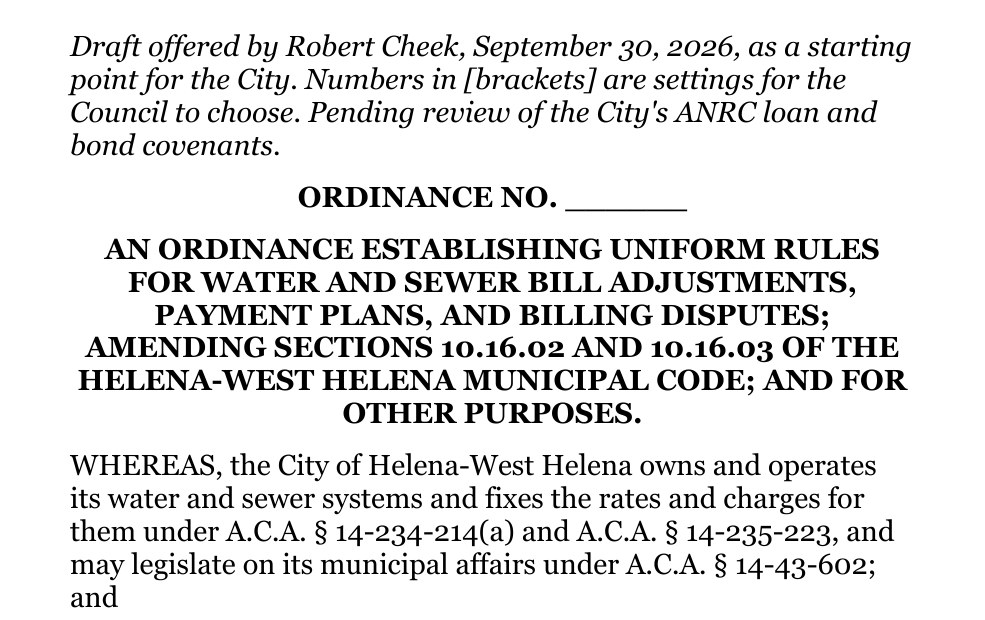
I wrote a draft ordinance. I sent it to Mr. Valley on Thursday and to the mayor and council on Friday, as a starting point they are free to use in whole or in part. Here is what it does, why it is written the way it is, and the one thing I am asking the council to do with whatever version it takes up.
Disclosure
I pay a water bill like everyone else, on a commercial account at my business. Under this draft I would get no special treatment. Section 10 bars any official or employee, or anyone in their household, from asking for or approving an adjustment on their own account.
Why I care about this
In September I wrote about water billing on this site and called for a written adjustment policy adopted by the council (read it here). Rates have more than doubled since 2024. Billing periods have stretched to 40 days. Estimated bills get "caught up" all at once. When a bill comes in high, the answer depends on the day and the person. Less than three weeks later, the city attorney raised the same need at the council table. That is good news. Now the details matter.
What the draft does, in plain words
If the city made the mistake. A bill that was too high because of the city (a misread meter, a broken meter, the wrong account, a math error) gets fixed and the money comes back. A bill that was too low because of the city still has to be paid, but you can pay the extra a little each month, with no late fee.
If you had a leak on your side of the meter. One leak adjustment every 12 months. Ask in writing within 60 days and show the repair. The city takes off half the cost of the extra water on up to 2 bills. If the leaked water went into the ground and not the sewer, the sewer charge on that water comes off too. That is the whole formula. Nobody can give more.
Estimated bills. Allowed only when the meter can't be read. The bill must say ESTIMATED. No more than 2 in a row. Any catch-up is spread over the same number of months, with no late fee.
Long billing periods. Every bill shows how many days it covers. A bill longer than 35 days can be split into 2 payments.
Payment plans. Anyone behind can sign a plan to pay the full balance over 4 months, or 6 months over $300. Keep up with the plan and there is no late fee and no shutoff on that balance.
Billing disputes. Every late notice and shutoff notice must say how to dispute the bill and who to call. While a written dispute is open, the water stays on, as long as you pay the part you don't dispute.
One process, written down. Every request goes on one form. The city answers in writing within 15 business days. Every request is logged, and the council gets a monthly report with no customer names.
The numbers above are the draft's suggestions. The council sets them. They appear in brackets in the full text.
Why it has to be an ordinance, and why it reads like a rulebook
State law makes it a crime for a city official or employee to furnish utility service except "at the usual and regular rates, and in the usual manner" § 14-42-108. A conviction removes the official from office. In 1997 the Arkansas Supreme Court upheld the removal of a mayor who cut customers' water and sewer bills outside his own city's review rule (Allen v. State, 327 Ark. 350).
That is why every credit in this draft follows a fixed formula and nobody can approve more. A written rule, applied the same way to every account, is "the usual manner." It protects customers, and it protects the employees at the counter who are asked to make these calls today with nothing to point to. The sewer statute also says sewer charges are set "by ordinance" § 14-235-223. A one-night resolution would be open to challenge.
What it does not do
- It does not change any rate or add any fee.
- It does not forgive what anyone owes. Plans and installments spread payments out. They do not cut them.
- It does not override the city's loan and bond agreements. If anything in it conflicts with those agreements, the agreements control. I have asked the city clerk for copies so they can be checked.
My one ask: post it and give it three readings
Arkansas law says an ordinance like this must be read at three separate meetings, unless 4 of the 6 council members vote to skip the rule § 14-55-202. Skipping it is common. I am asking the council not to.
Post the draft publicly before the first reading. Read it at three regular meetings, for example October 6, October 20, and November 3. That gives residents a month to read the rule that will decide their bills and tell their council member what they think.
Three readings add about four weeks. The bigger wait is set by state law either way: an ordinance like this takes effect 91 days after it passes § 14-55-203. Passed on October 6, it would take effect about January 5. Passed on November 3, about February 2.
If the council wants relief to start sooner, it has a tool for that too. It can add an emergency clause at final passage, on a separate vote of 4 council members, so the rule takes effect the day it passes Ark. Const. art. 5, § 1. Residents still get the three readings, and voters keep their right to petition it to a vote. That is the council's call. The three readings are the part I am asking for.
Now is when the rules get written
People come to city hall when a high bill arrives. Far fewer come when the rules for those bills are being written. Right now is when the rules are being written.
The council takes this up starting October 6. A written rule is a good step, and it will help a lot of families. The details decide whether it works: how big the credit is, how long a payment plan runs, who decides, and whether the public sees the reports. Those details get settled in the next few meetings, with or without us. Show up, read the draft, and use your voice while it can still change the outcome.
What you can do
- Read the draft. It is below in full, and you can download it as a PDF or Word file.
- Come to the council meeting on Tuesday, October 6. The city attorney is expected to present his recommendation.
- Tell your council member you want the rule posted and read three times.
If the city's version is better than mine, I will say so. What matters is that the rule is written down, fair to everyone, and that residents get to read it first.
The documents
The full draft and the laws cited above, readable right here. Statute text is from the official Arkansas Code (Code of Arkansas Public Access), current through the 2026 First Extraordinary Session.
Draft The draft ordinance, in full (offered to the city October 1-2, 2026)
ORDINANCE NO. ______
AN ORDINANCE ESTABLISHING UNIFORM RULES FOR WATER AND SEWER BILL ADJUSTMENTS, PAYMENT PLANS, AND BILLING DISPUTES; AMENDING SECTIONS 10.16.02 AND 10.16.03 OF THE HELENA-WEST HELENA MUNICIPAL CODE; AND FOR OTHER PURPOSES.
WHEREAS, the City of Helena-West Helena owns and operates its water and sewer systems and fixes the rates and charges for them under A.C.A. § 14-234-214(a) and A.C.A. § 14-235-223, and may legislate on its municipal affairs under A.C.A. § 14-43-602; and
WHEREAS, A.C.A. § 14-42-108(b)(1) forbids any city official or employee to furnish utility service "unless payment is made therefor to the municipal corporation at the usual and regular rates, and in the usual manner," and the Arkansas Supreme Court affirmed the removal from office of a mayor who adjusted customers' water and sewer bills outside his city's adopted review procedure, Allen v. State, 327 Ark. 350 (1997); and
WHEREAS, the City has no council-adopted rule for adjusting bills, arranging payment plans, or resolving billing disputes, and the City Attorney advised the Council on September 29, 2026 that such a rule must be adopted by the Council and applied to every customer the same way; and
WHEREAS, in a written report to the Council dated September 28, 2026, the Water and Sewer Department stated that customers experience fluctuating bills, estimated readings, and late bills, and that it will "apply consistent adjustment and payment-plan policies to qualifying circumstances"; and
WHEREAS, a single written rule, applied the same way to every account and reported to the Council each month, protects customers, employees, and officials alike;
NOW, THEREFORE, BE IT ORDAINED BY THE CITY COUNCIL OF THE CITY OF HELENA-WEST HELENA, ARKANSAS:
Section 1. Purpose. This ordinance sets the only permitted ways to correct, adjust, spread, or dispute a water or sewer bill. An adjustment, installment, or plan made under this ordinance is made "in the usual manner." No official or employee may adjust a bill, waive a charge, or arrange a plan in any other way.
Section 2. Definitions. In this ordinance:
(a) "Account holder" means the person in whose name the account is billed.
(b) "Department" means the Helena-West Helena Water and Sewer Department.
(c) "Superintendent" means the Water Superintendent or the director of the Department.
(d) "Normal monthly usage" means the average monthly usage of the account over its last [12] actual (not estimated) readings, or the actual readings available if fewer than [12].
(e) "City error" means a bill that is wrong because of the City, including a misread or misrecorded meter, a failed meter, a bill charged to the wrong account, or an arithmetic error.
(f) "Customer-side leak" means a leak in the account holder's service line or plumbing on the customer's side of the meter.
(g) "Billing period" means the days between the two meter readings a bill is based on.
Section 3. City-error corrections.
(a) When a bill is too high because of a city error, the Department shall recalculate it using actual usage or, if actual usage cannot be determined, normal monthly usage, and shall credit or refund the difference.
(b) When a bill was too low because of a city error, the account holder owes the correct amount. The Department shall bill the difference in equal monthly installments over a period no shorter than the number of months the error lasted, and no late charge shall apply to those installments while they are paid on time. Nothing in this section forgives any amount owed.
Section 4. Customer-side leak adjustments.
(a) An account may receive one leak adjustment in any [12]-month period.
(b) The account holder shall request the adjustment in writing within [60] days of the bill and provide proof that the leak was repaired, such as a plumber's invoice, parts receipts, or dated photographs. The Department may inspect the repair.
(c) The Department shall credit [50] percent of the volumetric water charge for usage above normal monthly usage on no more than [2] consecutive bills. Base charges are not credited.
(d) When the repair record or the Department's inspection shows that the leaked water did not enter the sewer system (for example, a yard line or outside faucet), the Department shall remove the volumetric sewer charge for usage above normal monthly usage, because no sewer service was rendered for that water.
(e) No other credit, reduction, or waiver may be given for a customer-side leak.
Section 5. Estimated bills.
(a) The Department may estimate a bill only when the meter cannot be reached, has failed, or cannot be read within the billing period.
(b) An estimated bill shall say "ESTIMATED" on its face.
(c) No account shall receive more than [2] estimated bills in a row without an actual reading.
(d) When an actual reading follows one or more estimated bills, any additional amount owed shall be billed in equal monthly installments over the same number of months the estimates covered, and no late charge shall apply to those installments while they are paid on time.
Section 6. Long billing periods. Every bill shall show the number of days in its billing period. When a billing period is longer than [35] days, the account holder may pay that bill in [2] equal monthly installments, and no late charge shall apply to the second installment if it is paid by the next regular due date.
Section 7. Payment plans.
(a) Any residential account holder with a past-due balance may enter a written payment plan with the Department.
(b) A plan shall repay the full past-due balance in equal monthly installments over no more than [4] months, or no more than [6] months when the balance exceeds $[300], in addition to each current bill.
(c) While the account holder pays each installment and each current bill by its due date, no late charge shall be added to the planned balance and service shall not be disconnected for that balance.
(d) An account may have only one active plan. An account holder who fails to keep a plan may not enter a new plan for [12] months.
(e) A plan repays what is owed. Nothing in this section forgives or reduces any balance.
Section 8. Billing disputes.
(a) Every late notice and disconnection notice shall state how to dispute the bill and name the Department employee who handles disputes.
(b) An account holder may dispute a bill in writing on or before the disconnection date.
(c) While a timely dispute is pending, service shall not be disconnected for the disputed amount, provided the account holder pays the undisputed amount and each current bill by its due date.
(d) The Department shall decide a dispute in writing, with its reasons, within [15] business days.
Section 9. Requests, decisions, and appeals.
(a) Requests under Sections 3 through 8 shall be made in writing on a standard form, on paper or by email.
(b) The Department shall decide each request in writing within [15] business days. Department staff may approve adjustments up to $[100]; the Superintendent approves larger adjustments. Every decision applies the formulas in this ordinance; no one may approve more than the formulas allow.
(c) An account holder may appeal a decision in writing within [30] days to [the City Council, which shall decide the appeal on the written record at a regular meeting] [a committee of the City Council designated by resolution]. The appeal body may only apply this ordinance.
(d) Customer billing information presented in an appeal shall be limited to what is needed to decide it.
Section 10. Officials and employees.
(a) No elected official, City employee, or member of their household may request, approve, or influence any action under this ordinance on an account they own, hold, or live at. Such requests shall be decided by [the Superintendent, or a designee with no connection to the account], and logged as such.
(b) When an elected official or employee makes a request on behalf of another person's account, the request shall be logged with the official's or employee's name and decided under this ordinance like any other request.
Section 11. Log and monthly report.
(a) The Department shall log every request under this ordinance, approved or denied, with the account number, the date, the type (city error, leak, estimate catch-up, long billing period, payment plan, dispute), the dollar amount, the decision, who decided it, and any request made under Section 10(b).
(b) Each month the Superintendent shall report to the Council the number and total dollar amount of adjustments by type, the number denied, the number of active and failed payment plans, and the number of disputes and their outcomes. The report shall not include customer names.
(c) The log is kept as a public record subject to the Arkansas Freedom of Information Act, A.C.A. § 25-19-101 et seq.
Section 12. Bond and loan covenants. Nothing in this ordinance changes any rate or charge, and nothing in it shall be applied to reduce the City's water or sewer revenues below the levels required by any bond ordinance, loan agreement with the Arkansas Natural Resources Commission, or other lawful agreement with bondholders or lenders. If any provision of this ordinance conflicts with such an agreement, the agreement controls.
Section 13. No new fees. This ordinance creates no new fee or charge.
Section 14. Amendments to the Municipal Code.
(a) Section 10.16.02 is amended by adding at the end: "The late charge and the right to disconnect service under this section do not apply to any amount being paid under an active payment plan, an installment, or a pending billing dispute under Ordinance No. ______ (Water and Sewer Bill Adjustments, Payment Plans, and Billing Disputes)."
(b) Section 10.16.03 is amended by adding at the end: "Late charges shall be assessed the same way for all customers, subject only to the uniform rules of Ordinance No. ______, which apply equally to every account."
(c) The due dates and disconnection dates of Ordinance No. 13-2021 remain in effect, except as provided in this ordinance for payment plans, installments, and pending disputes.
Section 15. Public hearing. Before final passage, the Council shall hold a public hearing on this ordinance, with notice published in a newspaper of general circulation in the City at least ten (10) days before the hearing, as provided in A.C.A. § 14-235-223(d).
Section 16. Review. The Council shall review this ordinance and the year's monthly reports each [January].
Section 17. Repealer. All ordinances and parts of ordinances in conflict with this ordinance are repealed to the extent of the conflict, except those described in Section 12.
Section 18. Severability. If any part of this ordinance is held invalid, the remaining parts remain in effect.
Section 19. Effective date. This ordinance takes effect as provided in A.C.A. § 14-55-203(c) after its passage and publication. It contains no emergency clause.
PASSED AND APPROVED this ____ day of __________, 2026.
______________________________ Mayor
ATTEST: ______________________________ City Clerk
Numbers in [brackets] are settings for the council to choose. Download as a Word file.