The new line on your Entergy bill
The short version
- A home that uses 1,000 kWh a month pays $5.74 a month for the new "Generating Arkansas Jobs Act" line. Entergy's own filing projects about $20 a month by 2030.
- It pays Entergy a return on three power plants that are still being built. None of them produces power yet.
- It comes from a state law passed in 2025. The state Public Service Commission sets the rate. The city council cannot change it.
- You can comment on it, get help with the bill, and tell our legislators what you think. The links are below.
Since June, Entergy Arkansas bills have carried a new line called "Generating Arkansas Jobs Act." A lot of people have asked me what it is. Here is what the public record shows.
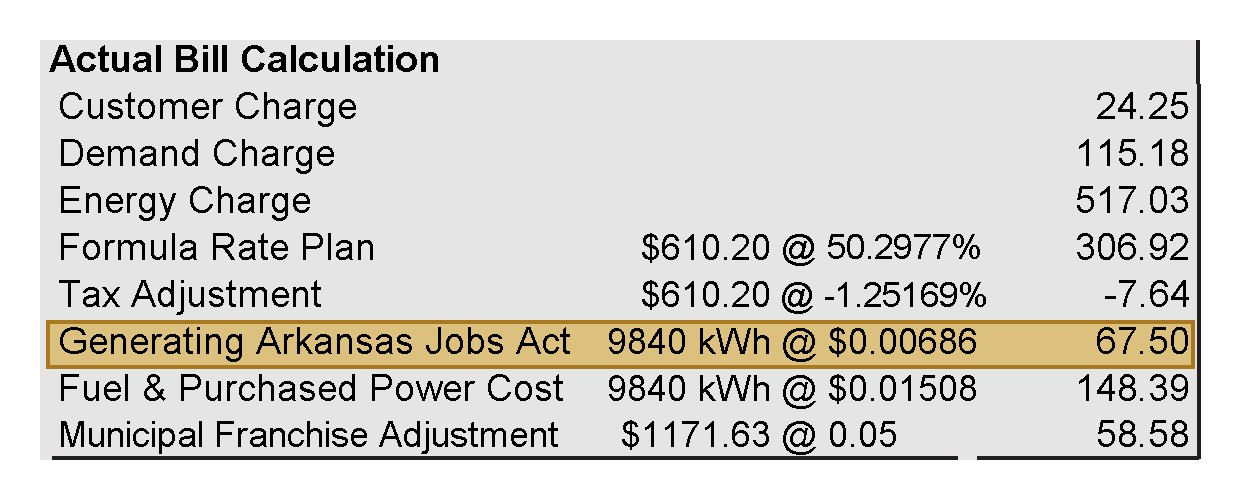
What it is
The charge comes from Act 373 of 2025, a state law passed in March 2025. The law lets Entergy charge customers for new power plants and transmission lines while they are still being built. Before this law, customers generally started paying for a plant after it went into service. Entergy says this approach lowers the total cost, because it avoids years of financing charges that would otherwise be added to a plant's price. Its public affairs director told a legislative committee on September 15 that it "saves money in financing costs that customers pay."
The Arkansas Public Service Commission set the current rate in June 2026. The residential rate is $0.00574 per kWh. At 1,000 kWh, that is $5.74 a month, before the city franchise fee and sales tax are added.
My own business pays the small-commercial rate of $0.00686 per kWh. On the Inn's June bill it came to $45.28.
What it pays for
This year the charge collects about $110 million from Entergy Arkansas customers. About $107 million of that is Entergy's allowed return on the $1.24 billion it has spent so far on three projects. In plain terms, that covers interest on what Entergy borrowed plus a profit for its shareholders, at about 8.6% a year before taxes. It does not pay off the plants themselves. That cost is added to regular rates once they are running. The three projects:
| Project | Type | Size | Expected in service |
|---|---|---|---|
| Jefferson Power Station | Gas | 754 MW | Dec. 2029 |
| Ironwood | Gas | 446 MW | Dec. 2028 |
| Cypress | Solar + battery | 600 MW + 350 MW | Dec. 2028 |
None of the three is producing power yet.
Cypress accounts for $1.76 of the $5.74. The Public Service Commission's record says Cypress is being built as a condition of an economic-development customer's contract. That customer is Google's data center in West Memphis. The terms of that contract are sealed. Entergy says Google will pay more than $2.1 billion over 20 years and that customers will come out ahead. That claim cannot be checked from the public record.
How long it lasts
The law has no end date. The charge is reset every year. Entergy's filing projects the residential charge for a 1,000 kWh home at:
| Year | Monthly charge |
|---|---|
| Now (June 2026) | $5.74 |
| June 2027 | $12.68 |
| June 2030 | $20.10 |
It rises because Entergy is still building. By Entergy's estimate, the three projects will cost about $3.9 billion in all, and the charge is figured on the total spent so far. Entergy projects that the yearly amount it collects will grow from $110 million this year to about $385 million in 2030. That projection covers only these three projects. The law lets Entergy add new ones.
The next reset is filed around March 2027 and takes effect with June 2027 bills.
Who approved it
The Legislature passed the bill 23-9 in the Senate and 77-13 in the House. Both of Helena-West Helena's legislators voted yes: Sen. Reginald Murdock, who was also a co-sponsor, and Rep. Mark McElroy.
The Public Service Commission approved the 2026 rates on June 4. Two parties objected.
The Attorney General's office objected to how the financing cost was calculated. Entergy counted only $61,596 of low-cost short-term borrowing against $1.24 billion of construction. In the Attorney General's view, that made the return customers pay higher than it should be. He asked the Commission to require Entergy to count more of the cheaper borrowing.
The Commission's own staff asked it to leave the Ironwood gas plant, $33.9 million, out of this year's charge, because the Commission had never formally found that the plant qualified as a "strategic investment" under the law.
The Commission overruled both. On Ironwood, it found the plant does qualify. On the financing cost, it wrote that it shared the Attorney General's concern, but that Act 373 did not give it the authority to require the change.
What the city can and cannot do
The city council cannot change this charge. Electric rates are set by the state Public Service Commission, not the city.
The city can file comments with the Commission, pass a resolution, speak at the Legislature's Joint Energy Committee, which is expected to hold another hearing on this in October, and help residents find bill assistance. It can also ask to become a party the next time Entergy files its annual update. The window to ask is seven days after Entergy files.
One more fact: the city collects a 5% franchise fee on Entergy bills, and that fee applies to this line too. On a $5.74 charge, that is about 29 cents a month.
Where I stand
The sections above are the record. This part is my opinion.
People are right to be upset about this charge. In Helena-West Helena the median household income is about $36,000, and nearly one in three residents lives below the poverty line. An extra $6 a month is real money here. An extra $20 a month by 2030 is more.
My concern is the design. We are paying for power plants years before they produce any power. Part of the cost is tied to a contract with one of the largest companies in the world, and the public cannot read its terms. When the state commission says it shares the Attorney General's concern but lacks the authority to act on it, the problem is in how the law was written.
I am not against new investment in Arkansas, and I would welcome it in Phillips County. My position is simple: a large new customer should pay its own way, and the public should be able to check that it does.
Here is what you can do this month:
- File a comment. The Public Service Commission takes public comments online on docket 26-008-TF: comment form. Say what this charge costs your household.
- Get help with the bill. Mid-Delta Community Services in Helena runs LIHEAP energy assistance for Phillips County. Entergy also offers level billing, which spreads costs evenly across the year.
- Check the sales-tax exemption. Households with income of $12,000 a year or less can exempt the first 500 kWh a month from sales tax (Arkansas DFA Form E-416).
- Tell our legislators what you think. Sen. Reginald Murdock and Rep. Mark McElroy represent Helena-West Helena. The Legislature's Joint Energy Committee is expected to hold another hearing on this in October.
If I am elected, I will ask the council to file a comment with the Public Service Commission on behalf of the city before Entergy's next annual update in March. I will also ask the city to work with Mid-Delta to hold a bill-help session in Helena, so residents can sign up for assistance in one place.
Sources
- Act 373 of 2025 (SB307), full text
- SB307 bill page: sponsors and roll calls
- Arkansas PSC docket 26-008-TF (2026 rates; Order No. 7, June 4, 2026)
- Approved rates by customer class
- PSC report: projects, costs, and 5-year bill projection (p. 10)
- Arkansas PSC docket 25-049-TF, Order No. 11 (rider design and bill-line name)
- KATV, "AR lawmakers question Entergy on Google data center power costs," Sept. 16, 2026 (Entergy testimony)
- My business's Entergy bills, June through September 2026 (my own)
- U.S. Census Bureau, American Community Survey 2020-2024 5-year estimates (Helena-West Helena income and poverty)